November is Prostate Cancer Awareness Month: a urologist names the biggest risk factors for cancer
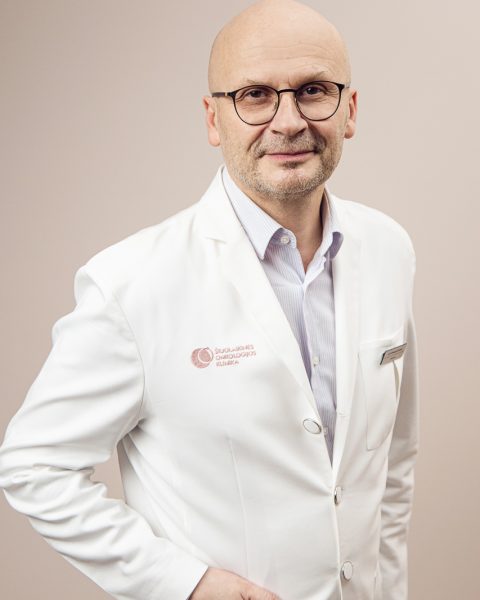
Prof. Mindaugas Jievaltas
Urologist. Has worked in urology for more than 26 years.
November is Prostate Cancer Awareness Month, a time when men are reminded how important it is to look after their health in good time, and society is encouraged to show solidarity with those who are ill.
Prof. Mindaugas Jievaltas talks about men’s attitudes to their health, the prostate cancer situation in Lithuania and the changes in the treatment of this disease over recent decades.

3,000 new cases every year
“Among cancers in men, prostate cancer holds a significant place – it is the most frequently diagnosed in our country,” urologist Prof. M. Jievaltas begins. “Survival, as is usually the case with cancer, depends on the stage: the earlier it is, the better the treatment results that can be achieved.”
According to the doctor, this is influenced by specific treatment that ensures a longer life without disease progression, with less pain that is better controlled, or with no pain at all. The main good news is that great progress has been made in treating advanced forms of the disease.
Statistics show that the incidence of prostate cancer in Lithuania is one of the highest in the entire European Union. According to the professor, this is the result of the early detection programme. Every year, the prostate cancer screening programme identifies more than 3,000 new cases, which account for as much as 30 per cent of all new cancer cases in men. However, in terms of mortality rates, we are about average in Europe.
A new generation of patients, but myths die hard
The doctor, who has worked in urology for more than 26 years, says that patients have changed considerably over the past decade. “After all, a new generation has grown up: better educated, more receptive and more curious,” says the urologist. “The digital age has played its part. Quite often, a patient who comes to see the doctor has already read up on the disease, asked artificial intelligence targeted questions and received fairly accurate answers.”
Although the new generation of patients is better informed and more confident, and treatment methods are more modern, false beliefs are still hard to shake off. According to the urologist, many men who feel fine do not go to the doctor and do not “go looking for illnesses”. However, this problem is gradually being addressed by raising public awareness of the prostate cancer screening programme and encouraging men to have their health checked in good time.
Another problem, familiar to urologists not only in Lithuania but throughout the European Union, is patients’ fear of the digital rectal examination. “We are gradually moving towards using electronic and radiological tools, genetic tests and so on for diagnosis. It is likely that in the future we will be able to avoid this examination, but certainly not now, because as many as one in five prostate cancers is detected by palpation. And that is quite a significant figure.”
According to the urologist, many men are still convinced that prostate cancer treatment always ends in erectile dysfunction. “The truth is that only surgical treatment can cause this side effect,” says Prof. M. Jievaltas. “In two thirds of patients, erections become weaker after surgery, but this problem can be treated with medication. If necessary, prosthetic surgery is performed to help preserve sexual function.”
The same can be said about urinary incontinence. “This problem occurs in about 15 per cent of men who have had surgery. If necessary, additional interventions are carried out, after which patients feel much better,” the doctor explains, adding that every specialist’s first goal is to cure the disease, and only then to correct any residual effects.
The disease is painless and has no symptoms
Many people know that prostate cancer has no specific symptoms, and that urinary problems are usually caused by the size of the prostate or an obstruction, not by this cancer.
Most often, men are diagnosed with localised prostate cancer. In as many as 40–50 per cent of patients, the cancer is at a very early stage, and in such cases the patient only needs active surveillance.
“The symptom of advanced prostate cancer is bone pain. The advanced stage is found in 7–8 per cent of all cases of this cancer. We would like there to be fewer of them,” says the doctor.
Asked about the risk factors for prostate cancer, the urologist stresses that first and foremost it is linked to older age. Genetic factors are no less significant.
“As with any other cancer, the environment we live in and the food we eat every day have an influence,” says the doctor. “However, there are no reliable studies showing which diet would help reduce the likelihood of developing prostate cancer. Nor is there any scientific evidence that particular dietary supplements can effectively reduce the incidence of this cancer.”
According to Prof. M. Jievaltas, there is no point in looking for miracle vitamins or believing the myths that a glass of red wine every evening or as many ejaculations as possible over a lifetime will help prevent prostate cancer.
“Speaking of all cancers, it should be said that their development is influenced by smoking, a lack of fibre in the diet and a sedentary lifestyle,” the doctor says, listing the three biggest risk factors.
Prostate cancer screening programme
The early detection screening programme for prostate cancer was launched in Lithuania in 2006. “When it was being created, I was one of its supporters – at the time there was nothing like it in Europe,” says Prof. M. Jievaltas. “The aim of such screening programmes is to reduce patient mortality. That was our aim too. And as research shows, after 15 years of the prostate cancer screening programme, mortality rates from this disease began to fall.”
The prostate cancer screening programme is intended for men aged 50 to 69 (inclusive) and for men from the age of 45 if their father or brothers have had this cancer. The date of the next check is set by the family doctor after assessing the results of the prostate-specific antigen (PSA) test. If the PSA level is above normal, the family doctor issues a referral to a urologist, who, if necessary, carries out a specific test – a prostate biopsy.
The Health Insurance Fund points out that if a man is not within the age range set by the programme but is worried about his health, he should not hesitate to contact his family doctor. After assessing the patient’s condition, the family doctor will order free tests and, if necessary, issue a referral for a specialist consultation.
Extended urology consultation at the Advanced Oncology Clinic
For an extended or repeat check-up, contact our urologists at the Advanced Oncology Clinic in Kaunas. For a more detailed assessment of your cancer risk, we invite you to see our urologists, who specialise in oncology. At our clinic, a thorough consultation assesses your individual situation and, if necessary, additional tests are recommended or an individual follow-up plan is drawn up.
Urology consultation in Kaunas
At our clinic (29 Vytauto Avenue, Kaunas), urologists and oncologists offer consultations. Book a preventive check-up and take care of your prostate health in good time.

