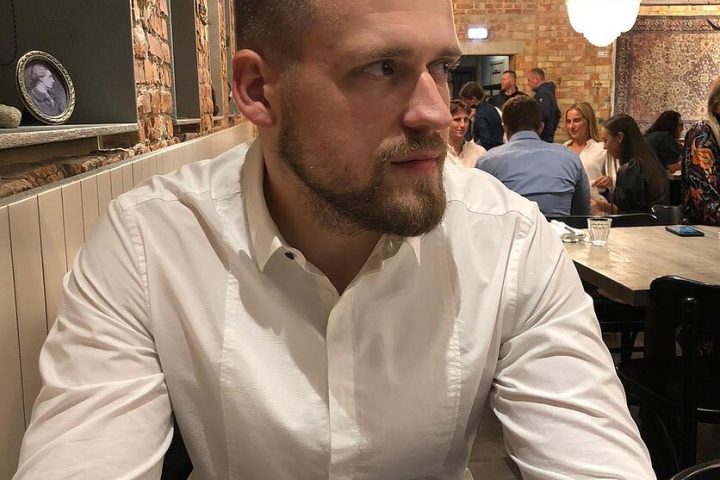
They will walk the hard road of illness together: fighting not against cancer, but for life

The loss of his first wife and a sense of helplessness in the face of illness grew into a desire to help others. At the only clinic of its kind in the country, which has opened in Kaunas, the fight is not against cancer, but for life.
No one suspected a thing
For Kristina, waiting for her first child was one of the most beautiful and memorable times of her life. No one suspected the changes that would soon affect the whole family.
“One day she felt unwell. When we went to the Hospital of Lithuanian University of Health Sciences Kauno Klinikos, we were told she was going into premature labour. Her blood results were good and there was no obvious illness, but labour was progressing all the same. The baby’s lungs were helped to mature, and two days later Kristina had a Caesarean section.” According to Egidijus Žilinskas, their son Dominykas, who had been due at the end of March, came into the world on 6 February.
Although he was born smaller, the boy grew steadily and was doing well. Unlike his mother. After giving birth, Kristina could not get out of bed and felt weak. One day, while carrying the bedpan, Egidijus noticed that her stool was black. This colour can be caused by iron supplements or other medicines, but black stool can also mean bleeding in the digestive tract. Gastroenterologist Prof. Dr. Kęstutis Adamonis performed a gastric endoscopy on the new mother and, having found several lesions, took a biopsy. The result: Stage III cancer.
“Kristina never complained. Yes, she sometimes had heartburn or indigestion, but show me someone who doesn’t,” says E. Žilinskas, who did not think these symptoms were warning signs of a serious illness.
A month after their son was born, Kristina had her stomach removed, and she began learning to live at a new pace – one dictated by the illness. Every step was accompanied by uncertainty and by questions that had never mattered before: what to do between courses of chemotherapy, how to help the blood recover, which foods to choose, what to do when insomnia strikes? Communication with doctors did not always go smoothly. Some lacked time, others lacked expertise.
“We often searched for information ourselves and talked to people who were ill. We even tried non-traditional treatments.” According to E. Žilinskas, the days became brighter after they met oncologist-chemotherapist Alvydas Česas. They travelled to Klaipėda to see him. At one point, Kristina achieved remission. Sadly, after a battle with the aggressive disease that lasted more than a year and a half, Kristina died.

Not a death sentence
For Kristina, the illness proved to be a death sentence, but cancer can often be managed, controlled and overcome. The most important thing is to detect it in time and to see specialists. “When someone develops cancer – whether breast, stomach or lung cancer – they ask: is this a fatal disease? I can tell you that it is not. Modern oncology allows us to work great miracles,” said oncologist-chemotherapist A. Česas, drawing on his many years of experience. “Ten or fifteen years ago, we used to say that once a malignant melanoma had metastasised, the patient had six months to live, and that was true. Now we can say that there are patients who have lived for fifteen years after their first immunotherapy. Or take lung cancer: in the past, around 80 per cent of patients died within the first two years. Only 3–4 per cent survived five years. Now we have patients who survive five, eight, ten years. That fundamentally changes the situation.”
In every case, according to the oncologist-chemotherapist, it is essential to work together – that is, to monitor patients actively, carry out tests and draw up a plan.
“These are very important matters, sometimes even more important than the treatment itself. That is why we all share the view that treating cancer requires cooperation, the work of all the teams, coordination and long-term, high-quality follow-up,” A. Česas stressed, adding that the patient’s own attitude is no less important.
It helps a person come to terms with the illness, drive it out of their body or learn to live with it. Leonas Kačinskas illustrated these words with his own example: five years ago, one of the country’s best psychiatrists was diagnosed with cancer. The survival prognosis was merciless – six months. Yet five years have passed, and he continues to do the work he loves, paints pictures, collects ties, cannot resist the temptation to drink his coffee from a different cup each time, and rejoices in every day that he greets as the sun rises.
“The problem with patients is that they have expectations. And expectations are tied to tomorrow, to other people. The greatest expectation is to enjoy this day. That’s all. Then there is no stress, no fear that you won’t live to see something. You need to enjoy the present, not wait. When you start waiting, you are not living. Then the next question is: if you are not living, why are you afraid of dying?” says psychiatrist L. Kačinskas. “The fact that I am alive is God’s will. Helping others today is a continuation of God’s will.”
Expertise and humanity
Today, Egidijus calls himself a happy man. By his side is his most loyal ally, helper and companion – his wife Sandra. Knowing about her husband’s past, she came to love his son Dominykas and gave the family a second joy – Leonardas. She supported her husband’s idea of founding a medical institution that would provide focused, specialised cancer care. This is how the Advanced Oncology Clinic was born.
“There are countless stories that can be changed. So I want to say once again that cancer can be controlled. Detected in time and treated properly, cancer can be an easier disease than diabetes,” said E. Žilinskas, co-owner of the clinic.
The Advanced Oncology Clinic is a kind of link between family doctors and tertiary-level medicine. It brings together highly competent specialists: oncologist-chemotherapist Alvydas Česas, oncologist-chemotherapist Assoc. Prof. Dr. Sigita Liutkausnienė, oncologist-chemotherapist Dr. Laura Kairevičė, haematologist Lina Neverbickienė, psychiatrist Leonas Kačinskas, surgeon Prof. Dr. Giedrius Barauskas, gastroenterologist, dietitian and psychotherapist Assoc. Prof. Dr. Aida Žvirblienė, gastroenterologist Prof. Dr. Kęstutis Adamonis, obstetrician and gynaecological oncologist Prof. Dr. Daiva Vaitkienė, plastic and reconstructive surgeon Prof. Dr. Rytis Rimdeika, dermatologist and dermatovenereologist Daiva Stanienė, and other leading experts in their fields. They diagnose, consult, carry out tests, provide second opinions and help patients stay strong at moments when they feel like giving up. Such moments are inevitable once active cancer treatment begins. In some cases, people even stop treatment because of them. That is why it is so important to stay in touch with the patient not only during chemotherapy, but also between sessions. Follow-up after active treatment has ended is also worthwhile, as a person may still be full of all kinds of fears. A cough may be just a sign of a cold, and back pain the result of sitting uncomfortably in a car, but for someone who has been diagnosed with cancer, these can cause great anxiety.
“Such a person will most likely not go to an oncologist and will keep worrying. They will become irritable, lose the will to live, lose their appetite and develop insomnia. At the clinic, we will try to help not only with medical means and not only by drawing on oncologists, surgeons, dietitians and other specialists, but also through a holistic approach using other methods. We will bring in psychiatrists and psychologists, help stabilise the situation and guide the patient along that path,” said A. Česas, convinced that when a person knows about their illness and what to expect from it, life becomes calmer.
That is why, in his view, communication with patients should be long-term. The clinic’s specialists would follow the patient’s history, and the patient would have an informal adviser on all kinds of questions.

Range of services
The Advanced Oncology Clinic plans to bring even more specialists together under one roof to help write more success stories. These include a nutrition specialist who will draw up plans based on blood tests, a pain specialist and a radiologist. In the future, the clinic is also considering certain services that would make patients’ daily lives easier.
“Something simple, but very important for women: where to buy a wig? It really is unpleasant to rush around shops looking for one, so we thought that perhaps manufacturers could come to the clinic,” says E. Žilinskas, who has more than one idea like this.
The clinic’s founders also dream of building a community of cancer patients who would gather for meetings. Lectures and yoga classes could be held for them.
Another point the clinic’s founders emphasise is prevention, which helps healthy people avoid the disease and helps those already diagnosed with cancer to significantly reduce the risk of recurrence. There are four such programmes in our country: early detection programmes for breast cancer, colorectal cancer and prostate cancer, and a cervical cancer screening programme. The clinic’s doctors will encourage people to take advantage of all the free programmes and will carry out tests for anyone concerned about their health.